
Five Signs Your Excavator Hydraulic Pump Is Failing
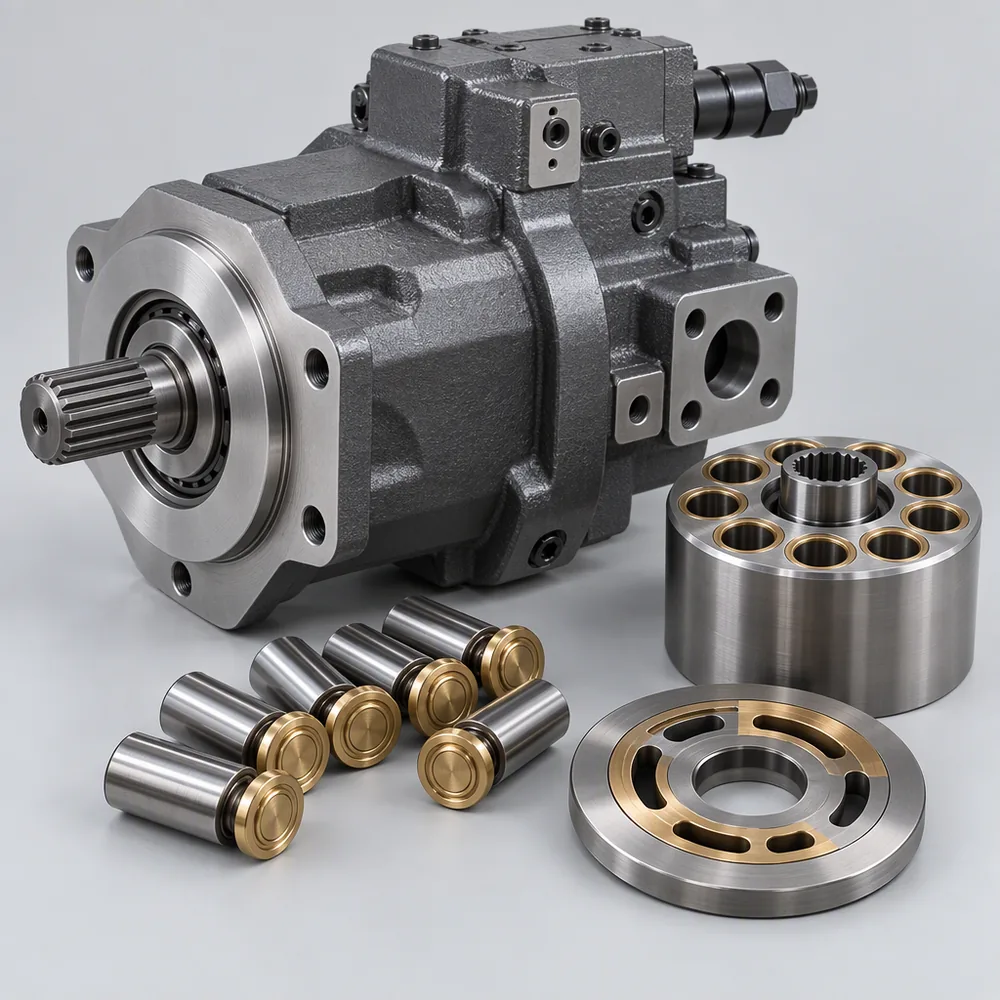
A main hydraulic pump rarely fails without warning. It degrades: clearances open up, internal leakage rises, and the machine slowly loses speed until the operator stops noticing the difference. By the time the pump seizes, the contamination has usually reached the valves and motors as well.
These five symptoms are the ones worth acting on early.
1. Cycle times get slower when the oil is hot
Cold oil is thick and masks internal leakage. If the machine is acceptable in the morning and noticeably slower after two hours of work, the pump is losing volumetric efficiency. Measure it: time a full boom raise from the same position, cold and hot, and compare.
2. Oil temperature climbs faster than it used to
Every litre of oil that leaks internally turns into heat. A pump at the end of its life will push hydraulic oil temperature up by 10–15 °C compared with a healthy unit doing the same work. Check the cooler first — but if the cooler is clean and the temperature still climbs, look at the pump.
3. Metal particles in the filter or the suction strainer
Cut open the return filter and look for brass or bronze-coloured particles. Piston shoes and cylinder blocks are the usual source. Fine grey paste is normal wear; flakes and chips are not. This is the single most reliable early indicator, and it costs nothing to check.
4. A whine that changes with load
Cavitation, air ingress or a failing bearing all produce noise, but they sound different. A steady whine that rises with load and disappears at idle usually points to internal leakage. A grinding or rattling note is mechanical — stop the machine and check the coupling and bearings before running it again.
5. Drift, weak digging and slow travel on one side
When one function is weak and the others are fine, suspect the function’s valve or cylinder before the pump. When everything is weak — boom, arm, bucket, travel — the pump is the common element.
Repair or replace? If the housing and shaft are serviceable, a rotating group rebuild (cylinder block, piston shoes, valve plate, bearings) usually costs a fraction of a new pump and restores most of the performance. If the housing is scored or the shaft is worn at the bearing seat, replace the unit.
Before you order a pump
- Record the pump model stamped on the housing — not just the machine model
- Note whether it is a single or tandem pump, and the regulator type
- Check the hydraulic oil and filters: a new pump in contaminated oil fails again quickly
- Ask whether a core exchange or parts-only option is available
Send us the pump model and a photo of the nameplate, and we will confirm whether a complete unit, a rotating group, or individual parts is the sensible buy for your machine.
Need this part quoted?
Send the machine model and quantity on WhatsApp — we confirm the match and reply within 12 working hours.